
You’re irreplaceable… and that’s the problem
Ask agency founders where they want to be in five years and the consensus is usually that they want to step back in some form. Sometimes selling up or stopping, other times it’s more about less time “in the business”. The common theme is “less of the day to day”.
I run an agency leadership peer research panel (The Agency Loop), which lets me ask questions like this en masse. When I did just that recently 56% of agency leaders expect to be out of the day-to-day business within five years, with another 12% within the following 5.
only 7% of agency leaders say they are completely confident their business can run without them for three months
Those aren’t surprising numbers to me. But in the same survey, only 7% of agency leaders said they were completely confident their business could run without them for three months, and 78% scored that confidence at 3 out of 5 or lower. That’s a worrying gap. Most expect to step back from the day-to-day, yet few are confident the business could cope without them for even a single quarter.
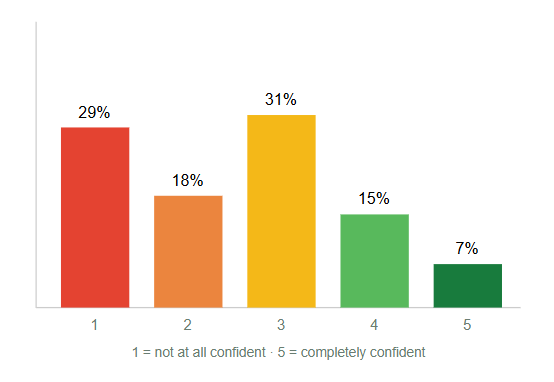
The Agency Loop panel covers agencies of many different sizes, and many of those who responded will not be building to sell, or are potentially early in that journey if they are. But 3 months is a low bar none the less. That isn’t forever, retirement or even particularly long term. It’s the length of break that life often throws at us in the form of grief, illness or other unfortunate circumstances.
I started with a survey about exits and future planning, but it mostly got me thinking about business resilience. A three month gap isn’t an exit. It’s a surprisingly common blip.
A three month gap isn’t an exit. It’s a surprisingly common blip.
Anyone who follows my writing regularly will already know that I had a blip like that myself. A couple of days before Christmas 2017 I got the most unwanted present ever: a surprise cancer diagnosis. I was on the operating table the following day and instantly out of the day to day of the business and at severely reduced capacity/capability for nearly 2 years, all with zero chance to plan or put measures in place for the business to function without me. I discuss that, and how we were able to survive it in another article “What breaks first”. The point though is that resilience is something I am acutely aware of and when I see figures like the ones above I hear alarm bells.
Put plainly: most agencies have a single point of failure, and it’s the founder.
It’s not really a size problem
The easy reading of that is “small agencies are fragile, big ones aren’t… so grow!” It’s the obvious conclusion, and one you will hear a lot. I think it’s wrong.
Discuss this in the LinkedIn thread →
The Agency Loop survey also asked how much of an agency’s revenue is delivered personally by the owner, broken down by size: At one or two people, the median was 99%. No surprise. At that size you are the agency. But by three to six people it drops to around 20%, and it doesn’t ease down gently. It falls off a cliff.
It’s tempting to read that as proof that growth buys resilience, but the commentary participants gave alongside the quantitative answers paints a more nuanced picture. Plenty of six-person agencies are still wholly dependent on the founder. Ten people, even. All of them busy, none of them able to make a call without you. What actually changes around that three-to-six mark isn’t how many people there are. It’s that, somewhere in there, most founders finally hire someone senior enough to take real work off their plate and own it. The cliff isn’t a size event. It’s a seniority event that happens to show up as a size.
This matters, because the two are easy to confuse (and confusing them is expensive!).
The two ways founders try to buy resilience (and why they don’t work)
When a founder feels like the single point of failure, there are two instinctive fixes. Both feel like progress. Neither tends to deliver it.
The first is to win more work. More clients, more pipeline, a salesperson, a better funnel. When I asked Loop respondents what would most need to change to give them more choice over their future, this was the loudest answer and I think it is counter productive.
More work doesn’t dilute your dependency; it amplifies it. The only person with the capacity and authority to absorb the overflow is still you. There is just more to absorb now. You don’t become less of a bottleneck by pushing more through the bottleneck.
The second instinct is to hire, but to hire cheap. More hands, junior salaries, affordable headcount. This looks like building a team, but it quietly recreates the same problem one rung down. A team of capable juniors (or increasingly, AI agents) still needs someone to make the decisions, carry the clients, own the hard calls. That someone invariably remains you, the founder. You’ve added cost and management load without adding a single person who could hold the business if you stepped out of the room.
One respondent in the survey summed it up perfectly: “I wasted years on people who were affordable but untested. It’s a false economy. It’s cost us millions in revenue and growth .” Cheap headcount is growth without resilience. It’s the worst of both: bigger, busier, and just as fragile.
The lever that actually works
The thing that buys resilience is seniority bought earlier than feels comfortable.
A genuinely senior hire of someone who’s done the job before, who can be trusted with a client relationship or a delivery call without you checking it, is the thing that removes you as the single point of failure. Not because they lighten the load, though they do, but because they become a second person the business can lean its weight on. That’s the whole game. Resilience isn’t one person doing less, it’s more than one person carrying the load. Reducing the impact of that single point of failure.
It almost never feels affordable at the time. A proven senior costs real money, and the maths rarely looks comfortable when you’re the one signing it off. But the founders furthest along in the Loop data said again and again that they’d have done it sooner if they had their time again. The expensive hire that scared them turned out to be the cheap option. The affordable looking ones were what cost them.
From experience, I would say there is a second way that it is uncomfortable that is also worth a brief discussion. Ignoring the cost, handing real responsibility to someone senior means letting go. Founders who have got to this point through strength of will and just getting shit done, rarely find it easy to delegate real authority, letting that senior hire apply their judgement and make calls that you would have made differently.
For many founders this is more difficult than the salary. I see it more noticeably with first time solo founders who are yet to understand the value of someone else taking the decision even if they think they could have made a better one themselves. Loosening the grip can be hard, but you can’t be replaceable and irreplaceable at the same time.
Where this leaves me
I started with a survey about exits and five-year plans. I’ve ended up thinking most of us are asking the wrong question, on the wrong timescale.
It isn’t “how do I grow?” Growth on its own can leave you exactly as fragile as you started, just with more people watching. And it isn’t “what’s my exit?”. That’s a question for a version of you that might be years away, if it arrives at all.
The question I’m hoping more readers are left considering is more immediate: who, other than me, could this business lean on if I couldn’t show up tomorrow? And then the harder follow-up, how soon can I afford to bring in someone good enough to be that person, and brave enough to let them?
Answer that, and most of the rest takes care of itself. The agency that can survive your worst quarter is the same agency someone would want to buy, the same one you could comfortably step back from, the same one that lets you take a proper holiday without your phone lighting up. The exit you’re half-planning for five years’ time and the resilience you need next Tuesday turn out to be the same piece of work.
I learned that the hard way, in an operating theatre two days before Christmas. Most people get a gentler prompt. Either way, the work is the same and it’s worth starting before life picks the timing for you.
The Agency Loop is a quarterly survey that surfaces exclusive data and peer insight from other agency leaders. It is free to take part of and every contributing agency leader gets full access to the resulting reports. Learn more and sign up here.
Try this…
Enjoyed this article? “Try this…” is a monthly email containing one short, practical play for you to try in your agency. Sign up here →
Mat Bennett
Advisor to founder-led agencies
